
Holidays After Divorce: Planning for Your Child with Special Needs
Practical steps and Illinois law for parents, attorneys and the professionals who support families
The holidays bring new places, late nights, crowds, unfamiliar food and a break from school. For a child with autism, ADHD, anxiety or a medical condition, those changes can be hard. When parents live apart, there are extra handoffs and two sets of plans, and the season can become overwhelming.
A plan made early, agreed in writing and built around the child’s needs is the best way to protect the holidays. This article covers the parenting plan, routines, transitions and co-parent communication. It ends with a checklist families can use now.
Start with the parenting plan
If you’re divorced or have a custody order, read your parenting plan now, before plans are made. It controls who has the child and when, and it usually takes priority over the regular weekly schedule during holidays.
In a 2024 Family Law Quarterly article, family law practitioners describe three priorities for parenting plans for children with disabilities: “(1) consistent schedules and predictable routines, (2) increased supervision and parental involvement, and (3) flexibility.” They call the written plan the “backup plan”: parents can agree to something different, but the plan governs when they can’t.
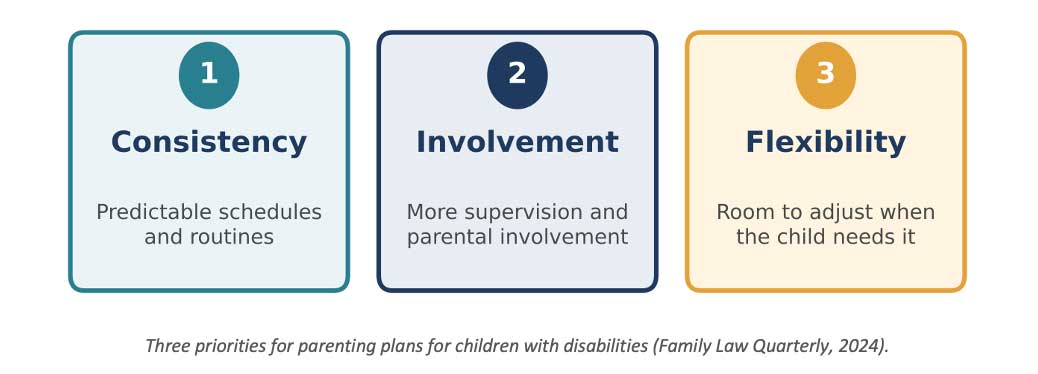
A strong holiday section in a plan for a child with special needs should cover:
- Exact start and end times for each holiday, and where exchanges happen. The authors caution that “special care must be taken to delineate the beginning and end time for each parent’s timeshare.”
- Fewer transitions where needed. Splitting a holiday in half gives both parents time, but two handoffs in one day may be too much for some children. Alternating whole holidays by year can work better.
- Therapy, medication and equipment during holiday time: who gives medication, which therapy sessions continue, and which home gets which supplies.
- Travel: advance notice, itineraries, and the child’s needs on planes or long drives.
- How changes are made, such as written agreement by a set date.
If the current plan no longer fits your child, for example after a new diagnosis or because the holiday split causes regression, talk with a family law attorney about changing it by agreement or through the court. Start well before the holidays, since courts and mediators get busy in November and December.
What Illinois law says
Illinois uses the terms “allocation of parental responsibilities” and “parenting time” instead of “custody” and “visitation.” Five parts of the Illinois Marriage and Dissolution of Marriage Act matter most for holiday planning.
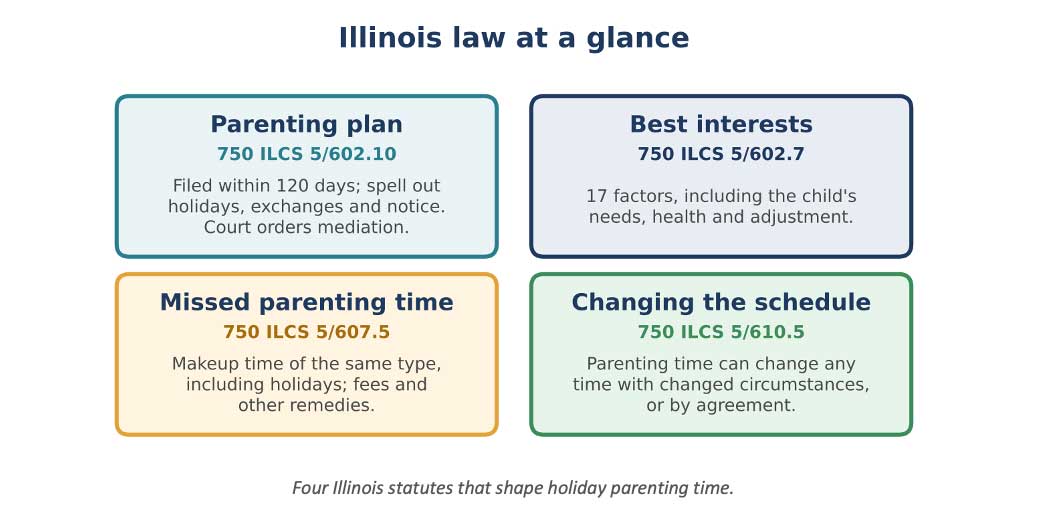
The parenting plan, 750 ILCS 5/602.10. Each parent must file a proposed parenting plan within 120 days after filing or service of a petition. The plan must include a schedule “in sufficient detail to be enforced,” transportation arrangements, and a requirement that each parent notify the other of “emergencies, health care, travel plans, or other significant child-related issues.” Holidays aren’t listed as a required item, so make sure yours are spelled out in the schedule. The plan may also include “any other provision that addresses the child’s best interests,” which is the place for medication, therapy and equipment terms.
Mediation. Under the same section, the court “shall order mediation” to help parents write, change or carry out a parenting plan, unless there are impediments such as domestic violence. Plans must also include a mediation provision for future disputes in most cases.
Best interests, 750 ILCS 5/602.7. In allocating parenting time, courts weigh 17 factors. Several bear directly on children with special needs, including:
- “the child’s needs”
- “the mental and physical health of all individuals involved”
- “the child’s adjustment to his or her home, school, and community”
- the parents’ daily schedules and “the ability of the parents to cooperate in the arrangement”
- each parent’s willingness and ability “to place the needs of the child ahead of his or her own needs”
Missed holidays, 750 ILCS 5/607.5. If a parent doesn’t follow the parenting time schedule, the other parent can ask the court for expedited enforcement. Remedies include makeup time “of the same type and duration” (holiday time for a missed holiday), counseling, parenting education, a bond, fines and contempt. Unless there’s good cause, the court must order the parent who violated the schedule to pay the other parent’s attorney’s fees and costs. The petition must show a reasonable attempt was made to resolve the dispute first.
Changing the schedule, 750 ILCS 5/610.5. Parenting time “may be modified at any time” after a substantial change in circumstances, if the change serves the child’s best interests. The two-year waiting period applies only to decision-making, not parenting time. Courts can also approve agreed changes and minor modifications without a showing of changed circumstances, which can help when a child’s needs make the current holiday split unworkable.
Illinois counties have their own local rules and standard holiday schedules. Check with your circuit court or a family law attorney about local requirements.
Keep care consistent in both homes
The homes don’t need to be identical, but the child’s core routines should travel with them.
- Medication: Send enough medication, plus dosing instructions, for the whole visit. Agree on timing so doses aren’t missed or doubled.
- Sleep: Keep bedtimes close to the school-year routine, even on late holiday nights.
- Food: Share dietary needs and safe foods with relatives who host meals.
- Sensory needs: Plan a quiet space at every gathering, and pack headphones or comfort items.
- Therapies: Decide together which sessions continue over the break and who takes the child.
- Duplicate key items: Keep a second set of essentials, such as pajamas, toiletries or a favorite cup, in each home so less has to travel.
Plan the transitions
Handoffs are often the hardest part of the season. A few steps can make them easier:
- Use a visual calendar in both homes. Family law attorney Lisa Zeiderman recommends a calendar showing which parent the child is with each day and “when (and where) custody changes happen.”
- Prepare the child ahead of time. Talk through who they’ll see, where they’ll sleep and what will happen. Social stories, photos of relatives and a countdown can help.
- Keep exchanges calm and predictable. Use the same place and routine each time. Avoid arguing or discussing problems in front of the child.
- Allow time to settle in. Plan a quiet first hour after each exchange instead of going straight to a big event.
- Plan for travel. Bring familiar items, plan breaks on long drives, and tell airlines in advance if your child needs assistance.
Communicate as co-parents
- Put plans in writing. Confirm holiday times, places and travel by email or a co-parenting app such as TalkingParents or OurFamilyWizard. A written record avoids “I thought you said” disputes.
- Share information about the child, not opinions about each other. Update the other parent on medication, behavior and sleep during the visit.
- Keep the child out of the middle. Don’t ask the child to carry messages or choose between parents, and don’t criticize the other parent where the child can hear.
- Settle disagreements early. Raise conflicts in October or early November, not on Christmas Eve. If you can’t agree, a mediator or parenting coordinator can help, and your parenting plan controls in the meantime.
- Be flexible when it helps the child. If the plan says one thing but your child is struggling, agree in writing to adjust that year.
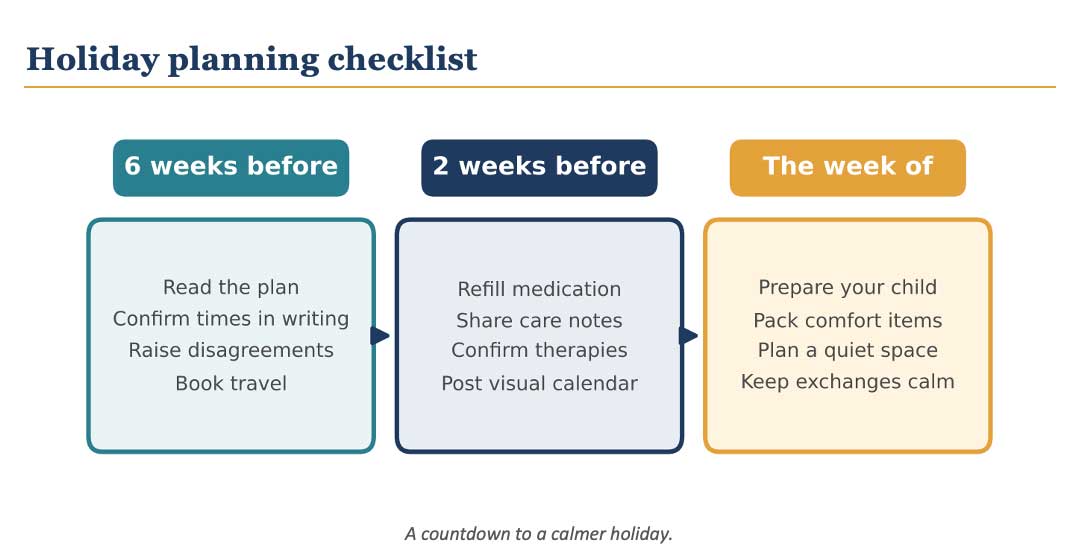
Six weeks before
- Read the holiday section of your parenting plan
- Confirm dates, times and exchange locations with the other parent in writing
- Raise any disagreements or requested changes
- Book travel and notify the other parent of itineraries
Two weeks before
- Refill prescriptions and pack enough medication for the whole visit
- Share care notes: medication schedule, foods, sleep, triggers and calming strategies
- Confirm which therapy sessions continue over the break
- Post the holiday schedule on a visual calendar in both homes
The week of
- Prepare your child with a social story, photos or a countdown
- Pack comfort items, headphones and any equipment
- Plan a quiet space at each gathering
- Keep the exchange calm, on time and predictable
For professionals
- Attorneys: Draft holiday provisions with exact times, exchange locations and a written process for changes. Address medication, therapy and equipment during holiday time. Consider alternating whole holidays when split days mean too many transitions.
- Guardians ad litem: Ask how the child handled last year’s holidays. Look for signs of regression after transitions, and report what you observe so the schedule can be adjusted.
- Mediators and parenting coordinators: Schedule holiday sessions in early fall. Help parents agree on details the plan doesn’t cover, and put agreements in writing.
- Therapists and teachers: Help families prepare the child with visual schedules and social stories before the break. Share strategies that work with both parents.
This article is for general information and is not legal advice. Custody laws and court procedures vary by state. For questions about your parenting plan, talk with a family law attorney.
Sources
- Margaret Pickard, Stephanie Holland and Neethy Eapen, “Creating Effective Parenting Plans for Children with Disabilities,” Family Law Quarterly 58-1 (ABA, 2024)
- Lisa Zeiderman, “Navigating Shared Custody When Your Child Is Neurodivergent,” Psychology Today (July 23, 2024)
- AFCC-Ontario, Parenting Plan Guide (Jan. 2020)
- McKinley Irvin, “Parenting a Child with Special Needs After Divorce” (Sept. 8, 2026)
- 750 ILCS 5/602.10, Parenting plan (Illinois General Assembly)
- 750 ILCS 5/602.7, Parenting time (FindLaw reproduction, current as of Jan. 1, 2025)
- 750 ILCS 5/607.5, Abuse of allocated parenting time (Illinois General Assembly)
- 750 ILCS 5/610.5, Modification (Illinois General Assembly)
