
Where IDEA Meets Section 504 and the ADA
How three federal laws protect students with disabilities, and what recent Supreme Court decisions mean for families and schools
One school failure can give rise to claims under three federal laws: the IDEA, Section 504 and Title II of the ADA. Each law has its own rules, procedures and remedies.
Three Supreme Court decisions since 2017 have changed how these laws fit together, and the most recent came in June 2025. Families now have clearer paths to court and, in some cases, to money damages. Schools face more risk when they fall short. This article explains where the laws overlap, where they differ, and what remains unsettled.
Where the claims overlap
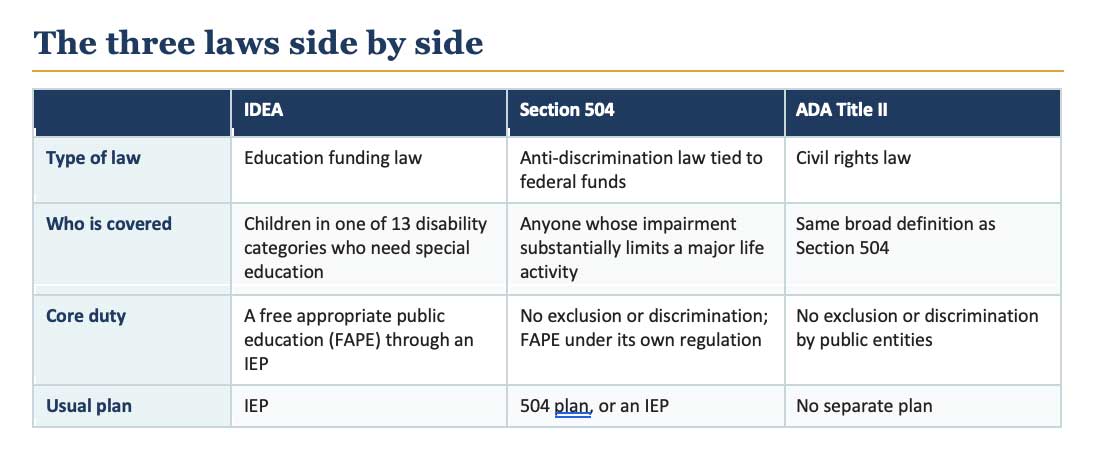
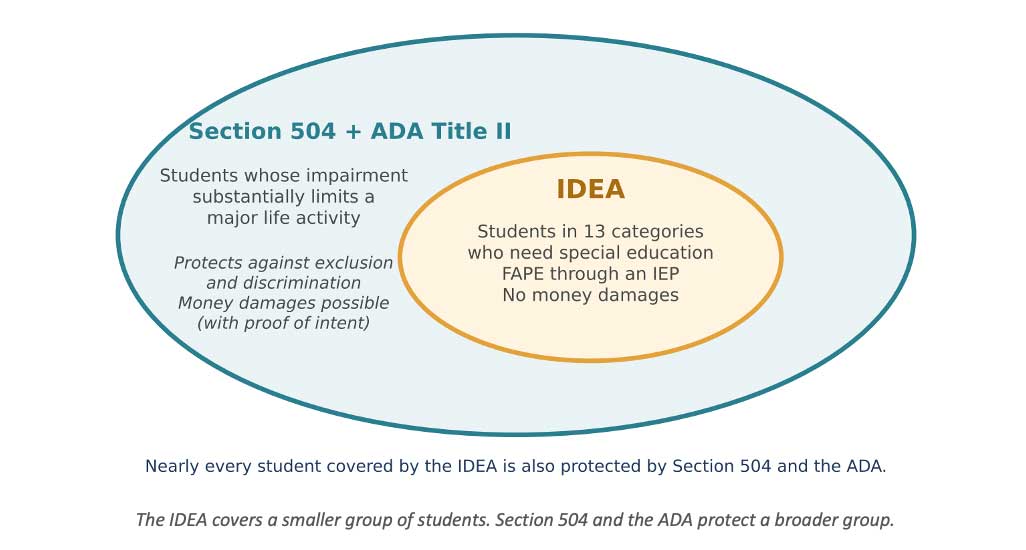
The overlap starts with FAPE. Section 504’s regulation, 34 C.F.R. § 104.33, requires schools to provide FAPE: education designed to meet a disabled student’s needs as adequately as other students’ needs are met. The regulation states that carrying out an IEP developed under the IDEA is one way to meet that standard. As a result, a school that denies FAPE under the IDEA often violates Section 504 too.
The overlap isn’t complete:
- The 504 standard compares students. The IDEA asks whether the IEP lets a child make appropriate progress, under Endrew F. Section 504 asks whether the child’s needs are met as adequately as other students’.
- Section 504 and the ADA reach beyond instruction. They cover disability-based exclusion, harassment, physical access, field trips, discipline and denial of reasonable accommodations, even when a child has no IEP.
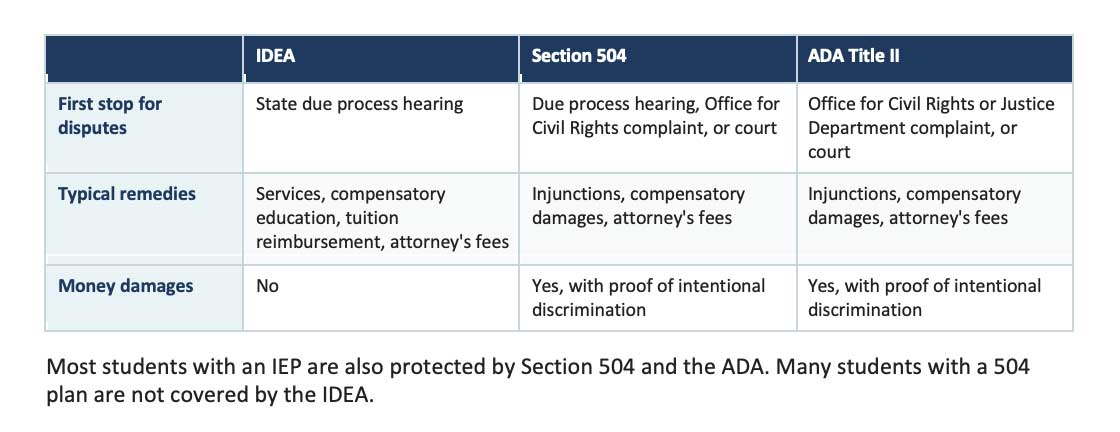
- Only Section 504 and the ADA allow money damages. The IDEA provides educational relief only.
In practice, one set of facts can support several claims. A child who goes years without reading instruction may have an IDEA claim for compensatory education. The same facts may support a Section 504 or ADA claim for damages, if the family can show the school acted with the required intent.
The Supreme Court cases that define the overlap
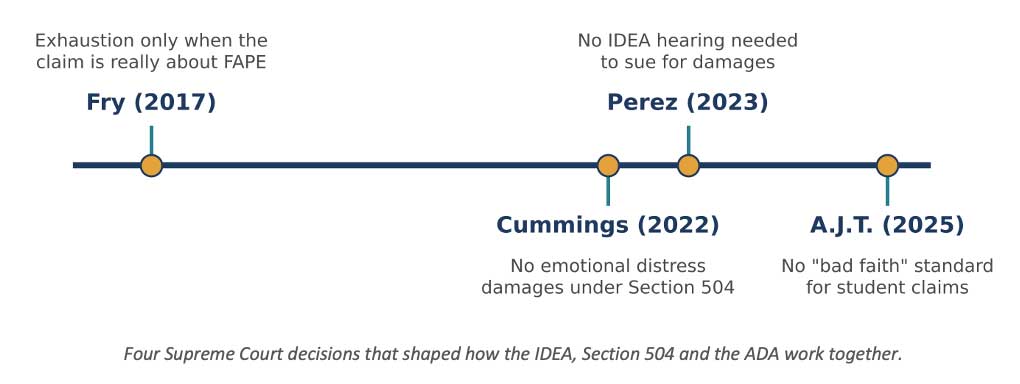
Fry v. Napoleon Community Schools, 580 U.S. 154 (2017)
A school barred a student’s service dog. Her family sued under Section 504 and the ADA without first pursuing an IDEA hearing. The Court held that families must exhaust IDEA procedures only when the “gravamen,” or essence, of the complaint is a denial of FAPE. Courts look past how the complaint is worded.
The Court offered two test questions:
- Could the family bring essentially the same claim if the conduct happened at a public facility that isn’t a school, such as a library?
- Could an adult at the school, such as an employee or visitor, bring essentially the same complaint?
If the answer to both is yes, the claim probably isn’t about FAPE. A family’s earlier use of IDEA procedures may suggest that it is.
Cummings v. Premier Rehab Keller, 596 U.S. 212 (2022)
This case arose outside schools, but it limits damages under Section 504. The Court held that emotional distress damages aren’t available under Spending Clause statutes, including Section 504. In 2026, the Ninth Circuit applied the same limit to ADA Title II in Payan v. Los Angeles Community College District. It also held that damages for lost educational opportunity remain available when proven with reasonable certainty.
Perez v. Sturgis Public Schools, 598 U.S. 142 (2023)
A deaf student received unqualified interpreters for years. His family settled the IDEA case and then sued under the ADA for compensatory damages. A unanimous Court held that the IDEA’s exhaustion rule applies only to suits seeking relief the IDEA can also provide. The IDEA can’t award compensatory damages, so the family didn’t need to finish the IDEA process before suing for them.
A.J.T. v. Osseo Area Schools, No. 24-249 (June 12, 2025)
A student with epilepsy needed evening instruction, and the district refused. The Eighth Circuit had required her to prove “bad faith or gross misjudgment” to win under Section 504 and the ADA. A unanimous Court rejected that rule. Students’ education-related claims are now subject to “the same standards that apply in other disability discrimination contexts.”
The Court noted the standards the courts of appeals use:
- Injunctive relief: generally available without proof of intent to discriminate.
- Compensatory damages: require intentional discrimination. Most circuits accept deliberate indifference, which doesn’t require ill will.
Exhaustion: when the IDEA hearing comes first
The IDEA, at 20 U.S.C. § 1415(l), preserves families’ rights under Section 504 and the ADA. But when a family sues under those laws for relief the IDEA could also provide, it must first complete the IDEA’s due process hearing.
Taken together, Fry and Perez give two questions:
- Is the claim really about FAPE? If not, as with a service-dog ban or a physical access barrier, no IDEA hearing is required.
- If it is about FAPE, what relief does the family want? Services, compensatory education or reimbursement generally require an IDEA hearing first. Compensatory damages don’t, after Perez.
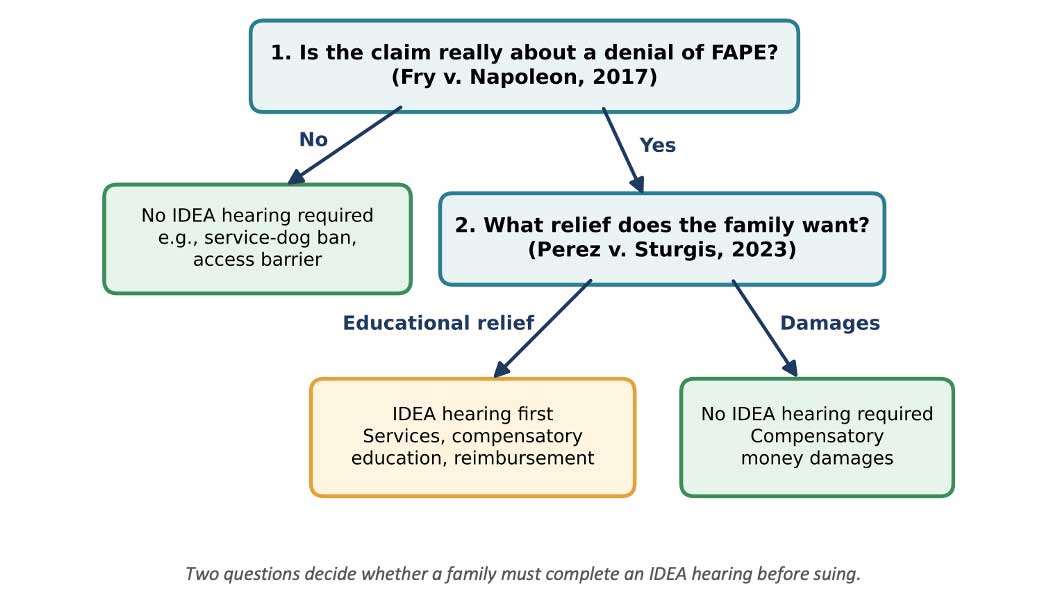
Many families still start with an IDEA hearing. It’s often faster than federal court, it can produce services quickly, and the record it creates can support a later damages case. Exceptions such as futility remain unsettled; Perez left that question open.
Open questions
- The intent standard for damages. J.T. left in place the lower courts’ rule that damages require intentional discrimination, usually shown by deliberate indifference. In a concurrence, Justice Thomas, joined by Justice Kavanaugh, signaled interest in revisiting these standards in a future case. Justice Sotomayor, joined by Justice Jackson, wrote that the statutes’ text doesn’t support a purpose-to-discriminate requirement. Expect continued litigation over what “intent” means.
- The scope of damages. After Cummings, emotional distress damages are off the table under Section 504. Courts are still working out whether the same limit applies under the ADA and how to measure lost educational opportunity.
- Section 504 regulations. In Texas v. Kennedy, states challenged 2024 Health and Human Services rules under Section 504. On September 23, 2026, a federal court in Texas entered a final judgment approving a settlement that vacated the rules’ community integration provisions. The judgment didn’t find Section 504 unconstitutional, and published summaries of the judgment don’t address any effect on the Education Department’s school rules.
Practical takeaways
For parents
- Name every law that applies. In written complaints and requests, refer to the IDEA, Section 504 and the ADA, not just the IEP.
- Keep records of what the school knew and when. Damages claims turn on whether the school knew about a need and failed to act. Emails, meeting notes and evaluation requests matter.
- Know the two paths. An IDEA hearing can get services quickly. A Section 504 or ADA lawsuit may bring damages, sometimes without an IDEA hearing first.
- Watch deadlines. Each law has its own filing deadlines, and they vary by state. Talk with a lawyer early.
For professionals
- Treat 504 compliance as its own obligation. A compliant IEP usually covers FAPE, but discrimination claims also reach discipline, access, harassment and activities outside the classroom.
- Respond to requests and document why. After J.T., there’s no “bad faith” shield. A record of ignored requests can support a finding of deliberate indifference.
- Remember that an IDEA settlement doesn’t end every claim. Perez lets families settle the IDEA case and still sue for damages.
- Train staff on the differences. Section 504 coordinators, IEP teams and administrators should understand all three laws.
This article is for general information and is not legal advice. If you have concerns about a particular child or school, talk with a qualified special education attorney.
Sources
- Fry v. Napoleon Community Schools, 580 U.S. 154 (2017), Cornell LII
- Faegre Drinker, Supreme Court Decides Perez v. Sturgis Public Schools (Mar. 2023)
- J.T. v. Osseo Area Schools, No. 24-249 (June 12, 2025), Cornell LII
- Lozano Smith, Emotional Distress Damages Off the Table in ADA Claims (on Cummings and Payan)
- Disability Rights Texas, Statement on Final Ruling in Texas v. Kennedy
- American Council of the Blind, Final Ruling Issued in Texas v. Kennedy