
504 Plan vs. IEP: What Every Parent Needs to Know
If your child has been identified as needing extra support at school, you’ve likely heard the terms “504 Plan” and “IEP” used — sometimes interchangeably. They’re not the same, and the differences matter enormously for your child’s education and legal protections. This guide breaks down what each plan is, who qualifies, what they look like in the classroom, and how to advocate effectively for your child.
The Legal Foundation: Two Different Laws
Understanding the difference between a 504 Plan and an Individualized Education Program (IEP) starts with understanding the laws behind them.
An IEP is governed by the Individuals with Disabilities Education Act (IDEA), a federal law that guarantees students with disabilities a “free appropriate public education” (FAPE) in the “least restrictive environment” (LRE). IDEA is an education law — its entire purpose is to ensure students with disabilities receive specialized instruction tailored to their unique needs.
A 504 Plan is governed by Section 504 of the Rehabilitation Act of 1973, a civil rights law that prohibits discrimination against people with disabilities in any program receiving federal funding — which includes public schools. Unlike IDEA, Section 504 was not written specifically for education; it applies broadly to workplaces, hospitals, and other settings. In schools, it ensures that students with disabilities have equal access to educational programs and activities.
This distinction matters because an IEP carries much stronger procedural protections and requirements. Schools have more specific legal obligations under IDEA — including timelines, required team members, and detailed documentation — than they do under Section 504.
Who Qualifies: Eligibility Differences
IEP eligibility is more narrowly defined. To receive an IEP, a student must:
- Have a disability that falls within one of 13 specific categories under IDEA (such as Autism, Specific Learning Disability, Emotional Disturbance, Other Health Impairment, Speech or Language Impairment, and others), AND
- The disability must adversely affect educational performance, AND
- The student must need specially designed instruction as a result.
All three conditions must be met. A child can have a diagnosed disability and still not qualify for an IEP if the school determines the disability doesn’t affect their academic performance or require specialized instruction.
504 Plan eligibility is broader. A student qualifies if they have a physical or mental impairment that substantially limits one or more major life activities — which can include learning, reading, concentrating, thinking, communicating, or caring for oneself. There is no list of qualifying conditions; a much wider range of diagnoses can qualify, including ADHD, anxiety, diabetes, food allergies, or physical impairments that don’t require specialized academic instruction but do require accommodations to access school equally.
In short: all students who qualify for an IEP also have rights under Section 504, but many students who qualify for a 504 Plan would not meet the higher bar for an IEP.
What They Look Like in the Classroom
Despite sharing the goal of supporting students with disabilities, 504 Plans and IEPs look very different in practice.
A 504 Plan provides accommodations — changes to how a student accesses or demonstrates learning, without changing what they are expected to learn. Common 504 accommodations include:
- Extended time on tests and assignments
- Preferential seating
- Reduced homework load
- Use of a calculator or spell-checker
- Frequent breaks
- Access to a quiet testing environment
A 504 Plan does not provide specialized instruction. The student is expected to meet the same academic standards as their peers; the plan simply removes barriers that would otherwise prevent equal access.
An IEP provides specially designed instruction — meaning the curriculum, instructional methods, or performance expectations may be modified to meet the student’s individual needs. An IEP includes:
- Specific, measurable annual goals
- A description of the special education services to be provided (and how often)
- Related services such as speech therapy, occupational therapy, or counseling
- Accommodations and modifications
- Transition planning for students 16 and older
An IEP is a much more comprehensive, individualized document — and significantly more resource-intensive for schools to implement. It also comes with more robust legal protections, including the right to a due process hearing if parents disagree with the school’s decisions.
Key Differences at a Glance
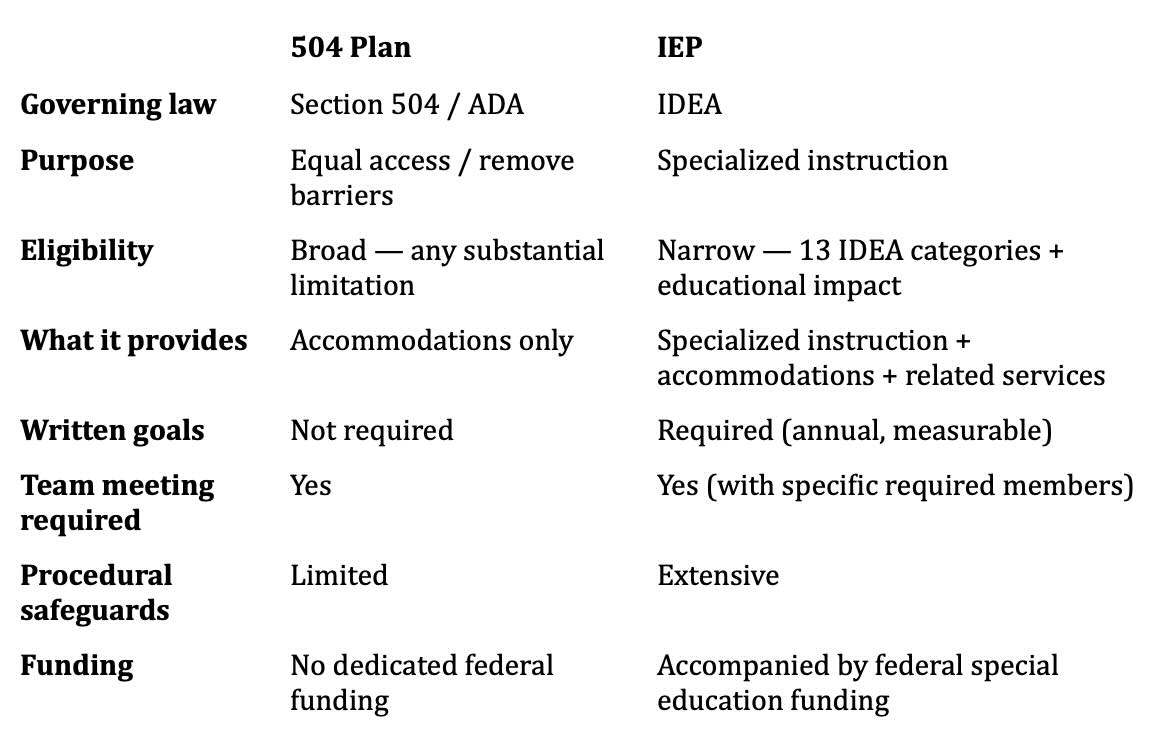
How to Advocate for Your Child
Whether you believe your child needs a 504 Plan or an IEP, the process starts with a request — and you have rights at every step.
1. Put your request in writing. Verbal requests can be ignored or forgotten. Send a written letter or email to the school principal or special education coordinator asking for an evaluation. Keep a copy for your records.
2. Know your timelines. Under IDEA, schools generally have 60 days (or the state’s timeline) to complete an evaluation after receiving your written consent. Under Section 504, timelines are less prescriptive, but schools must act within a reasonable time.
3. Participate actively in the meeting. You are a required member of the IEP team — not a guest. Come prepared with observations about your child’s strengths and challenges, recent evaluations or medical records, and questions about proposed services. For a 504 meeting, bring the same preparation even though your role isn’t codified in the same way.
4. Don’t accept “they don’t qualify” without asking why. Schools sometimes deny eligibility for reasons that don’t hold up under the law. Ask for the denial in writing and request the specific rationale. If your child was denied an IEP, ask whether they qualify for a 504 Plan instead.
5. Ask for an Independent Educational Evaluation (IEE). If you disagree with the school’s evaluation, you have the right under IDEA to request an IEE at the school’s expense. This brings in an outside evaluator who is not employed by the district.
6. Get help if you need it. Parent Training and Information Centers (PTIs) exist in every state and provide free support to parents navigating special education. A special education advocate or attorney can also help if you reach an impasse with the school.
The Bottom Line
Neither plan is “better” than the other — they serve different purposes for students with different needs. A 504 Plan may be the right fit for a child who can access grade-level curriculum but needs certain barriers removed. An IEP is appropriate for a child who needs instruction that is genuinely different in content, approach, or pacing.
What matters most is that your child receives what they actually need — not what is easiest for the school to provide. Understanding the legal framework behind these plans puts you in a stronger position to ask the right questions, push back when necessary, and ensure your child’s rights are protected every step of the way.
Have questions about your child’s rights under IDEA or Section 504? Contact us — we’re here to help